


 Click here to read the article
The refraction technique traditionally used to determine the corrective cylinder for a prescription has changed very little over the years, mainly due to the limitations imposed by subjective phoropters, which present lenses in increments usually no smaller than 0.25 D.
Today, thanks to phoropters with continuous power changes that allow to simultaneously and accurately act on sphere, cylinder and axis, it is now possible to develop new refraction techniques. This series of three articles describes the principles of a new vectorial method for determining the corrective cylinder and presents the rationale for an associated automated cylinder search algorithm.
Article from the magazine "Point de vue"

 Click here to read the article
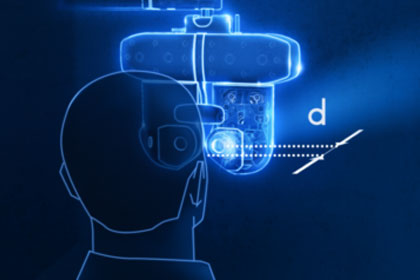
Although the effect of vertex distance on optical correction is well known, it is rarely taken into account in practice, except in cases of very strong corrections. When ophthalmic lenses were offered only in 0.25 D increments, this had little influence on most corrections.
But today, with refraction determined in 0.01 D increments* and the lenses associated with them, knowledge and measurement of vertex distance becomes particularly important. This article reviews the optical effects of vertex distance, shows how eye-to-phoropter distance can vary and discusses how vertex distance can now be taken into account for an accurate calculation of corrective lens power.
Article from the magazine "Point de vue"

 Click here to read the article
Myopia has become such an epidemic that the World Health Organization describes it as a key risk factor for ocular pathologies that can lead to blindness. As eyecare professionals and public health authorities respond to the crisis, this article offers a strategic approach with effective mechanisms for myopia control. This approach is based on three pillars of intervention: managing the environments of young people with myopia, managing their ametropia and peripheral defocus, and treating anomalies in binocular vision.
Article from the magazine "Point de vue"

 Click here to read the article
Traditionally, in the ophthalmic lens industry optical corrections have been offered in increments no smaller than 0.25 D. But patients are often sensitive to smaller dioptric changes. A study carried out by Essilor International at its Singapore R&D centre with a representative sample of patients showed that 95% were sensitive to dioptric changes of under 0.25 D and that 44% could distinguish between changes of less than 0.125 D. This article presents the results of the study and demonstrates how a patient’s sensitivity can influence the precision of their refraction result. It also explores the outlook offered by the new high-precision subjective-refraction techniques and the ophthalmic lenses associated with them.
Article from the magazine "Point de vue"